Commercial Roof Restoration vs. Full Roof Replacement
Not every aging commercial roof needs a full tear-off. This guide walks through the roof age, moisture, damage extent, and budget factors that determine whether restoration or replacement is the right call for your building.
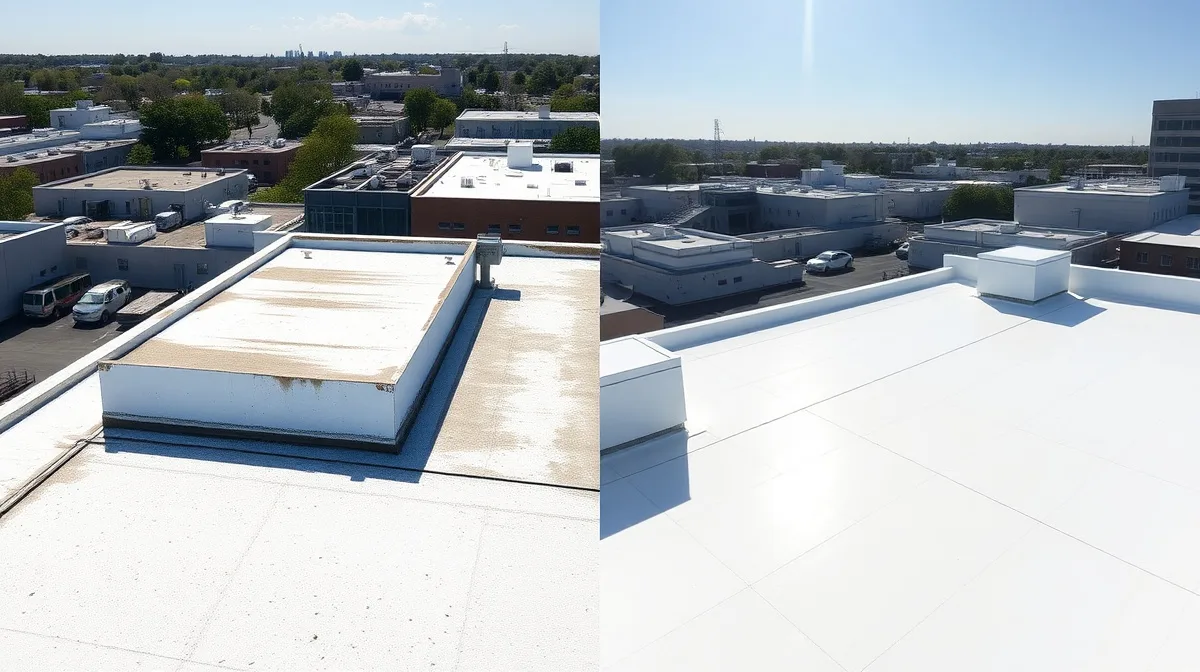
Every commercial property owner and facility manager eventually faces the same question when a roof starts showing its age: repair it, coat it, or replace it? The honest answer is that it depends on what's actually happening underneath the surface, not just what the roof looks like from the parking lot. We're an independent, certified applicator of Conklin-brand roof coating systems, and we make our living installing restoration systems — but that doesn't mean restoration is always the right answer. A roof with sound decking, manageable moisture levels, and structurally intact insulation is usually an excellent restoration candidate. A roof with widespread saturated insulation, structural deck deterioration, or damage that's outrun any reasonable recoat cycle is a replacement candidate, and we'll tell you that directly.
This page exists to walk through the actual decision factors — roof age, moisture condition of the deck and insulation, how much of the roof is affected by damage, and where you are in your capital budget cycle — so you can make an informed call before a contractor of any kind sets foot on your building. Because we work nationwide across metal, single-ply (TPO/EPDM/PVC), built-up/modified bitumen, and spray foam roof systems, we've seen this decision play out across nearly every substrate type and building class. The short version: restoration is almost always the lower-cost, faster, less disruptive path when the roof qualifies, and replacement is the right move when the underlying structure is already compromised. Our job as your applicator is to tell you honestly which category your roof falls into — not to sell you the option that's better for us.
Why property owners choose it
- A properly scoped moisture survey tells you the true condition of your deck and insulation before any money is spent, removing guesswork from the decision.
- Restoration candidates typically cost a fraction of full tear-off and replacement, freeing capital budget for other building priorities.
- Coating restoration work is generally completed in days, not the weeks a full tear-off and reroof can require, minimizing disruption to tenants and operations.
- Qualifying installations can carry Conklin-backed NDL (No-Dollar-Limit) material and labor warranty terms, giving you documented protection either way.
- An honest assessment protects you from paying twice — once for a coating system installed over a roof that actually needed replacement, and again for the replacement itself.
- Because we install across metal, single-ply, BUR, and spray foam substrates, our recommendation isn't steered by only knowing one system.
Roof Age and Remaining Service Life
Age alone doesn't disqualify a roof from restoration, but it's the first filter we apply. A single-ply membrane, metal roof, or built-up system that's within its expected service window and hasn't been neglected is frequently a strong restoration candidate, regardless of whether it's five years old or twenty. What matters more than the calendar is whether the roof has been maintained along the way — a roof with a documented history of flashing repairs, seam maintenance, and drainage upkeep ages differently than one that's been left alone.
Where age becomes disqualifying is when a roof has already been recoated once or twice and is showing the same failure patterns returning faster each cycle, or when the membrane or panel system itself is at the point where further coating cycles would be chasing a substrate that's no longer holding up. In that case, a restoration recoat is a short-term patch on a longer-term problem, and we'll say so rather than sell another cycle. Our starting question on every inspection is simple: how many more good years does this substrate have left in it, coated or not?
- Roofs within their expected service window with a maintenance history are typically strong restoration candidates
- Repeat failure patterns after a prior recoat cycle signal the substrate — not just the surface — is wearing out
- Metal, single-ply, BUR, and spray foam each carry different realistic service-life expectations we factor in separately
Deck and Insulation Moisture Condition
This is the single most important factor in the entire decision, and it's the one that shows up least in a visual inspection from the ground. Trapped moisture in the insulation or deterioration in the deck itself doesn't go away with a coating — it gets sealed in. Coating a roof over saturated insulation or a compromised deck doesn't fix the underlying problem; it hides it while the damage continues underneath the new surface.
That's why any serious restoration-vs-replacement evaluation includes a real moisture assessment — infrared scanning, core sampling, or moisture-meter probing depending on the substrate — not just a walk-around. If moisture is isolated to a few identifiable areas, targeted deck repair or wet-insulation replacement followed by a full restoration system is often still the right call. If moisture has spread broadly across the roof field, or the deck shows structural softness in multiple locations, that's typically the point where restoration stops making sense and replacement becomes the responsible recommendation — for your building's safety and your long-term cost, not ours.
- Trapped moisture under a coating is a hidden problem, not a solved one
- Infrared scanning and core sampling give a real answer where visual inspection alone cannot
- Isolated wet areas can often be repaired and restored; widespread saturation usually points to replacement
Extent of Existing Damage and Your Budget Cycle
Beyond age and moisture, we look at how much of the roof's total area is affected by active damage — ponding water that never clears, membrane splits, widespread seam separation, or metal panel rust that's progressed past surface-level. A roof with damage concentrated in a handful of repairable spots is usually restorable. A roof with damage spread across most of the field, or damage that's compromised the roof's structural integrity in multiple places, generally isn't.
Budget cycle matters too, and it's worth naming directly. If your capital budget for a full reroof isn't approved for another one or two fiscal years, but the roof is actively leaking now, a restoration system can be the right bridge decision — buying real, warrantable service life while you plan and fund a longer-term replacement on your own timeline instead of being forced into an emergency reroof. That's a legitimate use of restoration, and we'll help you think through it that way rather than pretending it's a permanent fix if it isn't.
- Damage concentrated in specific, repairable areas typically supports restoration
- Widespread structural damage across the roof field typically points to replacement
- A restoration system can serve as a funded, warrantable bridge ahead of a planned future reroof
- Emergency leak conditions don't always mean emergency replacement — sometimes they mean immediate restoration
Ideal for
- Facility and property managers who need a documented, defensible case for their capital planning committee or ownership group
- Building owners who've received conflicting recommendations from different contractors and want a straight answer
- Portfolios with multiple roofs at different ages where a prioritized restoration-vs-replacement plan is more useful than a single yes/no answer
- Anyone evaluating a roof nearing the end of its expected service life who wants to know if that life can be reasonably extended
- Property managers weighing a near-term budget cycle against a roof that's showing wear but hasn't failed
What affects the cost
Restoration vs. Replacement questions, answered
We start with a full inspection covering roof age, a moisture assessment of the deck and insulation (often infrared or core sampling), and the extent of existing damage across the roof field. Those three factors together — not a single walk-around — determine the honest recommendation.
Not when the roof qualifies. A properly specified restoration system on a sound deck with manageable moisture conditions typically extends service life by 10-15+ years and can carry a Conklin-backed material warranty. It's only a temporary fix if it's applied over a roof that actually needed replacement, which is exactly what a real moisture and damage assessment is meant to prevent.
Isolated wet areas are common and usually don't rule out restoration. We typically recommend removing and replacing the affected insulation in those specific spots, then coating the full roof as a system. It's when moisture has spread broadly across the field that replacement becomes the more responsible call.
Often, yes. If the underlying deck and insulation are still sound, a restoration system can serve as a funded bridge that stops active leaks and buys real years of service life while you plan and approve a longer-term reroof on your own budget cycle, instead of being forced into an unplanned emergency replacement.
Yes. As an independent, certified applicator of Conklin roof coating systems, our reputation depends on giving property owners an honest recommendation, not pushing restoration onto a roof that's already structurally compromised. When replacement is the right call, we say so.
Restoration vs. Replacement done right, by a certified applicator crew
Restoration vs. Replacement isn't a commodity — the result depends entirely on how carefully it's prepped and applied. We assess what your roof actually needs, prep the substrate properly, and apply Conklin-brand coating systems to manufacturer specification, so the work delivers the durability and reflectivity it's supposed to. No shortcuts, no builder-grade rush.
We serve residential and commercial property owners nationwide. Every job starts with a free, no-pressure roof inspection, and every estimate is our own project pricing — never presented as official Conklin corporate pricing.
Just as important, we treat your roof like the system it is. Substrate condition, prep quality, coat count, and topcoat selection all interact, and getting one right while ignoring the others leaves durability on the table. When we scope your restoration vs. replacement, we look at how it fits the whole roof, so the finished result performs the way it should for years to come.
Free inspection
We evaluate your roof and give you a clear, itemized estimate with no pressure.
Certified application
We prep and apply your restoration vs. replacement to manufacturer spec — clean and on schedule.
A roof you can trust
A durable, reflective restoration and honest guidance on Conklin-backed warranty terms.
Related services
Ready for a free restoration vs. replacement estimate?
Tell us about your roof and we'll put together a clear, no-pressure coating estimate — commercial or residential, anywhere in the country.